Sunday, December 16, 2012

Dag Walker, American Writer, Goes to Prison, Iquitos, Peru

"Welcome to the penal colony at Devil's Island, whose prisoners you are, and from which there is no escape."
Papillon, (1973)

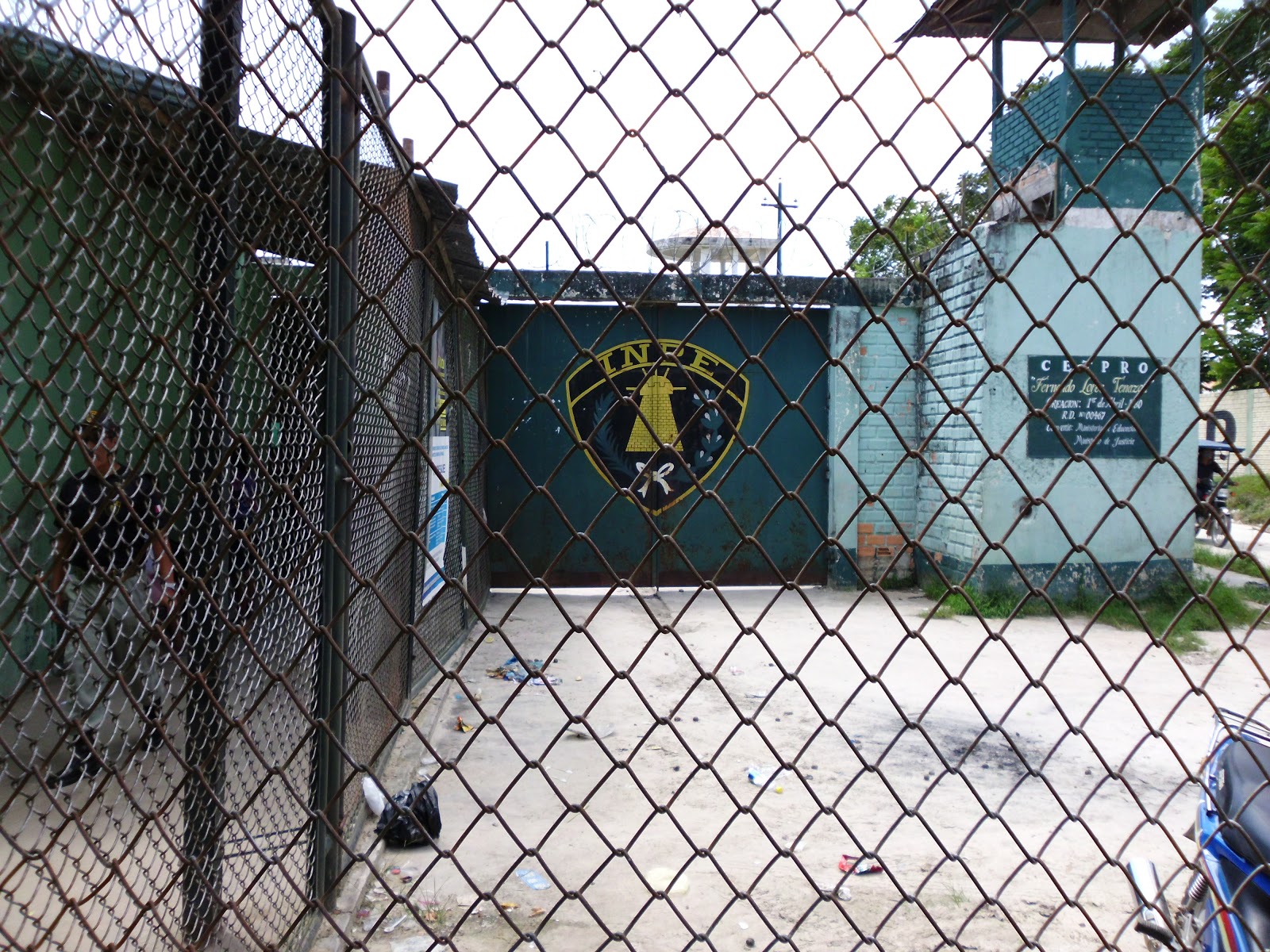
That's what I heard when we approached the gates to Iquitos' regional jungle prison.


The penitentiary of Iquitos, Establecimiento Penal para Sentenciados e Inculpados de Maynas (Epsim)- Penitentiary establishment for Sentenced and Accused of Maynas, has been categorized by various organizations as unsafe; roofs about to collapse, stairs missing for guards to get up onto the watch towers and exposed electrical circuits are among the main problems. Currently, the jail holds 644 people, 55 of those being women....
Iquitos penitentiary posses danger to inhabitants.” 17 Feb. 2006
http://archive.peruthisweek.com/news-1259-iquitos-penitentiary-posses-danger-to-inhabitants/


I didn't do it, man. It wasn't my fault. But I went to prison in Iquitos, Peru anyway. Some people will be surprised not that I went but that they let me out.In fact, they kept me out.


INPE. Max. Sec.
I thought I had it all worked out for a trip to prison, meeting the ladies who would sign me in so I could see the life of crime that doesn't pay.
 
Waiting to sign in.

 I was pretty interested in signing in. I'm surprised they didn't lock me up for that alone.

Dag was captiviated.


But they bounced me. I think it's because of the way I was dressed.

My two companions and a boy who wanted to adopt me.

I try again next week. You can't keep a good man out.

Brasil St. 1904 - First jail in Iquitos, Peru
http://scottiquitos.blogspot.com/
My day started out like most days in Iquitos, me longing for the freedom of the open road, me looking out at the world from my sort of home. And then, I went to prison! This was not my first time. I was in prison in Alexandria, Egypt over a decade ago. They treated me badly. And now, prison in Peru.

Like a photo, I was framed!


Live without fear


When I went to prison in Egypt it was as a journalist, and I showed up with papers in hand, dressed like a professional there to write a feature about two young men sentenced and ready to be hanged the day I arrived. The convicts were awaiting death by hanging for a murder of a man found stabbed to death, the suspects convicted on the strength not of evidence but because they confessed to the heinous crime, whoever committed it not being of much importance, justice having to be seen to be done to anyone unfortunate enough to be grabbed for that purpose. And a travesty of justice it was. I was turned away and threatened with some minor violence in the form of a captain of the prison shaking his fist at my nose, telling me that there are no hangings in Egypt, and that the nation of Allah doesn't kill it's prisoners. So I missed the action. Nor did I get paid for my trip and my dead story. going to prison in Iquitos is something of a different tale to tell.

Today the prison is officially called INPE, "The National Penitentiary Institute," and it operates 57 of the country's active prisons. The locals call it "Penal." It's not so pretty.

Unlike the former leper colony on the north east side of South America at Devil's Island, French Guiana, there is no mountable guillotine ready to dispatch convicts in the heat of day as assembled men stare sullenly at their miserable lack of a future and watch as the blade falls on yet another poor bastard whose days are done. But it's bad enough for most prisoners at El Penal, Iquitos, Peru.

In 2010, Human Rights Report states:
Prisoners with money had access to cell phones, illegal drugs, and meals prepared outside the prison; prisoners who lacked funds experienced much more difficult conditions. Overcrowding, poor sanitation, and inadequate nutrition and health care were serious problems. Inmates had intermittent access to running water, bathing facilities were inadequate, kitchen facilities were unhygienic, and prisoners slept in hallways and common areas for lack of cell space. There was basic medical care at most prisons, but there were complaints that inmates had to pay for medical attention. There was also a lack of doctors; only 54 doctors worked at the country's 71 prisons, with 34 based in the capital city area. Tuberculosis and HIV/AIDS reportedly remained at near-epidemic levels. The San Juan de Lurigancho men's prison held 8,730 prisoners in a facility designed for 3,204.

Prisons for women were also overcrowded and marked by conditions similar to those for men. In an INPE-operated facility for women opened in 2008, prisoners continued to complain about dormitory-style sleeping quarters. INPE operated a high-security prison in the jungle area of Iquitos that was in poor condition and remained under renovation.

Prison guards and fellow inmates reportedly abused prisoners. Guards received little or no training or supervision. There were killings in prisons, most attributed to fellow inmates. In addition, during a December inspection in Lurigancho prison, authorities found the body of Leslie Dayan Paredes, a visitor, in the cell of her boyfriend. The inmate, Jackson Sanford Staling Conket, confessed to killing Dayan and hiding her body when she visited him in August, and authorities suspended police personnel for failing to notice that she never checked out of the prison.
http://www.state.gov/j/drl/rls/hrrpt/2010/wha/154516.htm


So, the guy kills his girlfriend in August and no officials notice the body till December. It might not be Devil's Island, but it's not a luxury resort either.


A typical Miércoles [Wednesday] at the Iquitos local prison, 26 de Octubre 2011


Knives (and the usual tijeras, cuchillos, desarmadores, hojas para cortar fierro, cinceles, ganzúas, punzones y navajas) at the local lock-up, Iquitos, Peru.
http://www.rpp.com.pe/2010-01-21-festival-salsa/2011-10-26-requisan-licuadoras-televisores-y-navajas-en-penal-de-iquitos-noticia_416385.html


You can get yourself killed there, and you can get yourself raped. You can also buy yourself a beer and have a party. 

Rita Ruck [legal assistant for the human rights office of the Apostolic Vicariate of Iquitos] estimates that about half of the 600 male inmates in the Iquitos prison, which was built to house 300, were arrested on charges of rape of a minor under age 14.

http://www.catholicnews.com/data/stories/cns/0602361.htm

On June 5, [2010] in Iquitos, Loreto Region, the director of the La Voz de Nauta program of Radio Anaconda, Salomon Valle, received anonymous telephone death threats that demanded he withdraw his complaint against the Nauta [the nearest (largish) settlement by road from Iquitos] police station chief, Major Armando Ludena, for allegedly seducing a minor. Valle had published photographs of the alleged act on Radio Anaconda's Facebook page.
 http://www.state.gov/j/drl/rls/hrrpt/2010/wha/154516.htm


It's a drag that I am banned from prison in Iquitos, but this is not the last word. I am determined to go to prison, and I'll get there regardless of how I have to do it. I'll try again next week and we'll take it from there.

A gentle reminder that my book, An Occasional Walker, is available at the link here:

http://www.amazon.com/Occasional-Walker-D-W/dp/0987761501/ref=sr_1_1?s=books&ie=UTF8&qid=1331063095&sr=1-1

And here are some reviews and comments on said book:

http://nodhimmitude.blogspot.com/2012/04/dagness-at-noon.html


No comments: